
Why the Second Payment Cannot Be Accelerated
Two payments sent back to back from the same wallet form a chain, and the second one spends an output the first one created. That makes the child invisible to any accelerator until the parent confirms: no tool can push a transaction whose inputs do not yet exist on chain. A miner at 88 TH/s earning $3.34 a day can easily spend more than a day of income on fees while working through the sequence in the wrong order.

Key takeaways
- A transaction spending unconfirmed coins cannot be accelerated; the parent must be mined first.
- Chain two payments and you may need two separate requests, each with its own fee and its own quota slot.
- Free eligibility still requires size at or under 0.5 KB and a fee rate of at least 0.0001 BTC/KB.
- At 88 TH/s, $4.23 of fees is more than the $3.34 a day the machine grosses, so chain length has a real cost.
A chain is not a queue of independent payments
Wallets rarely say "this payment depends on that one". They simply build the next transaction from whatever spendable coins they have, and if the change from an earlier payment is the only candidate, the new transaction inherits the dependency. On chain the relationship is explicit: the child names the parent's output as its input, so a node will not accept the child into a block until the parent is already there.
For the sender this produces a confusing screen. The wallet shows two pending items, the second with a lower confirmation count that never advances. Nothing is broken. The child is waiting for a parent that has not been mined, and no amount of fee on the child changes that order.
What the accelerator sees when it looks at the child
The ViaBTC TX Accelerator checks inputs before it checks fee rates. If an input is unconfirmed, the request stops there regardless of how generous the fee is, because including the child would require including an output that does not exist yet. The correct target is the parent: accelerate that one, wait for it to be mined, and the child becomes eligible on its own merits.
This is why two submissions are sometimes needed rather than one, and why the total cost of clearing a chain is the sum of the legs. It is also why a wallet that batches a payout into many small outputs can create a chain without the operator intending anything unusual. Consolidation is the usual culprit: spend twenty small coins at once and the resulting transaction is both larger and slower.
The 88 TH/s frame of reference
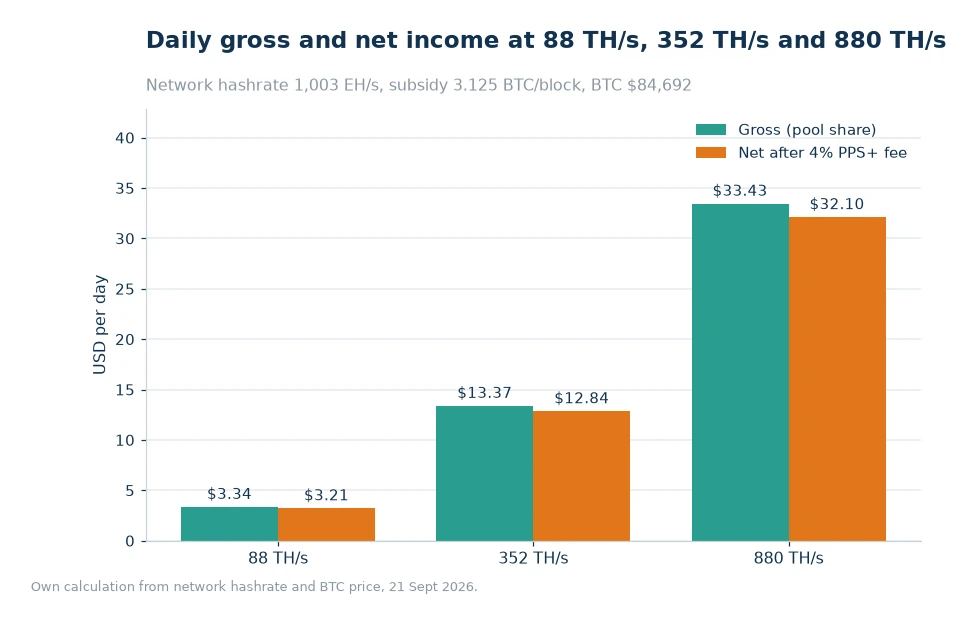
Mining income gives the fee decision a scale. At 88 TH/s the account credits 0.00003948 BTC a day, $3.34 gross and $3.21 after the listed 4% on the block-reward component. Two half-kilobyte legs at the free-route minimum carry 0.0001 BTC of total fee, about $8.47 — two and a half days of gross income for a machine of that size.
At 880 TH/s the same $8.47 is a quarter of a day's $33.43, which is why large operations treat acceleration as a rounding error and small ones do not. The tool's pricing is flat in dollar terms; the burden is entirely a function of how much the account produces.
The sequence that clears a chain
Start at the oldest unconfirmed transaction and work forward. Confirm its size and fee rate, submit it if it qualifies, and leave the child alone until the parent is mined. If the parent is too large for the free route, decide whether the paid option is cheaper than waiting; the child will still be waiting afterwards, and its own fee may need attention too.
Watching the parent is easier with an alert than with a browser tab. The ViaBTC app pushes status changes to a phone, which matters when the next step depends on a confirmation arriving at an inconvenient hour. Set the notification before submitting, not after.
Recording the order for next time
The cheapest fix for a chain is to avoid building one. Wallets that let you choose which coins to spend, or that wait for change to confirm before spending it, remove most of the problem. Where the wallet does not offer that, spacing payments by an hour or two is often enough for the parent to confirm at normal fee rates.
Keep a note of the transaction IDs in the order they were broadcast. When something stalls, that list turns a puzzle into a checklist: first unfinished item, act on it, then move down. The note also makes a support conversation shorter, because the sequence is the first thing anyone will ask for.
A short log pays off in a second way: it shows how often the wallet chains payments at all. Three chains in a month is a wallet setting worth changing; one is weather. Write the date beside each entry so the pattern is visible without opening a block explorer to reconstruct it later.
Three states on the way to confirmation
The table follows one chained pair from broadcast to settlement. The middle column is what a priority request would return at that moment, and the right column is the action that actually helps.
| Stage | Request outcome | Useful action |
|---|---|---|
| Parent broadcast, child broadcast | Parent accepted; child refused for unconfirmed input | Submit the parent only, then wait |
| Parent mined, child still pending | Child now eligible on its own size and rate | Submit the child in the next quota window |
| Both mined | Nothing left to accelerate | Check the fee total against the amount moved |
| Parent too large for the free route | Paid option offered in BTC, BCH or LTC | Compare the fee with the value at stake |
Worked example
Price a two-leg chain against a modest mining account.
- One terahash is worth 450 ÷ 1,003,000,000 = 0.00000044865 BTC of daily output.
- 88 TH/s: 88 × 0.00000044865 = 0.0000394812 BTC a day.
- Gross dollars: 0.0000394812 × 84,692 = $3.3437, rounded to $3.34.
- After the listed 4%: 3.3437 × 0.96 = $3.2099, rounded to $3.21.
- Two 0.5 KB legs at 0.0001 BTC/KB: 2 × 0.00005 = 0.0001 BTC.
- Fee in dollars: 0.0001 × 84,692 = $8.4692.
- Days of gross income at 88 TH/s to cover it: 8.4692 ÷ 3.3437 = 2.53 days.
- The same fee at 352 TH/s is 0.63 of a day; at 880 TH/s, 0.25 of a day.
Frequently asked questions
Why is my second transaction not eligible for acceleration?
Because it spends an output from the first transaction, which is still unconfirmed. The child cannot enter a block before its parent, so the request is refused until the parent is mined.
Can both payments be cleared in one request?
No. Each transaction is submitted separately, with its own size, fee rate and quota slot. Accelerating the parent does not automatically accelerate the child that follows it.
How do I stop a wallet from chaining payments?
Have it wait for change to confirm before spending it, or choose which coins to spend. If neither option exists, spacing payments by a couple of hours usually lets the first one settle.
Fix the parent, then look at the child
Open the wallet's transaction list, sort by broadcast time, and identify the oldest item without a confirmation. That is the only one worth submitting. Everything downstream is waiting on it, and submitting in that order avoids paying twice for a problem that one request can solve. Keep the account balance funded for the fee currency so the decision is not delayed by a deposit.
Input rules and fee conditions from the accelerator page, read 21 Sept 2026[1]; the chain figures behind the dollar column were 1,003 EH/s, 132.76 T and $84,692 per BTC. Published 24 Oct 2026. Fee arithmetic assumes two 0.5 KB legs at the free-route minimum and no other inputs.